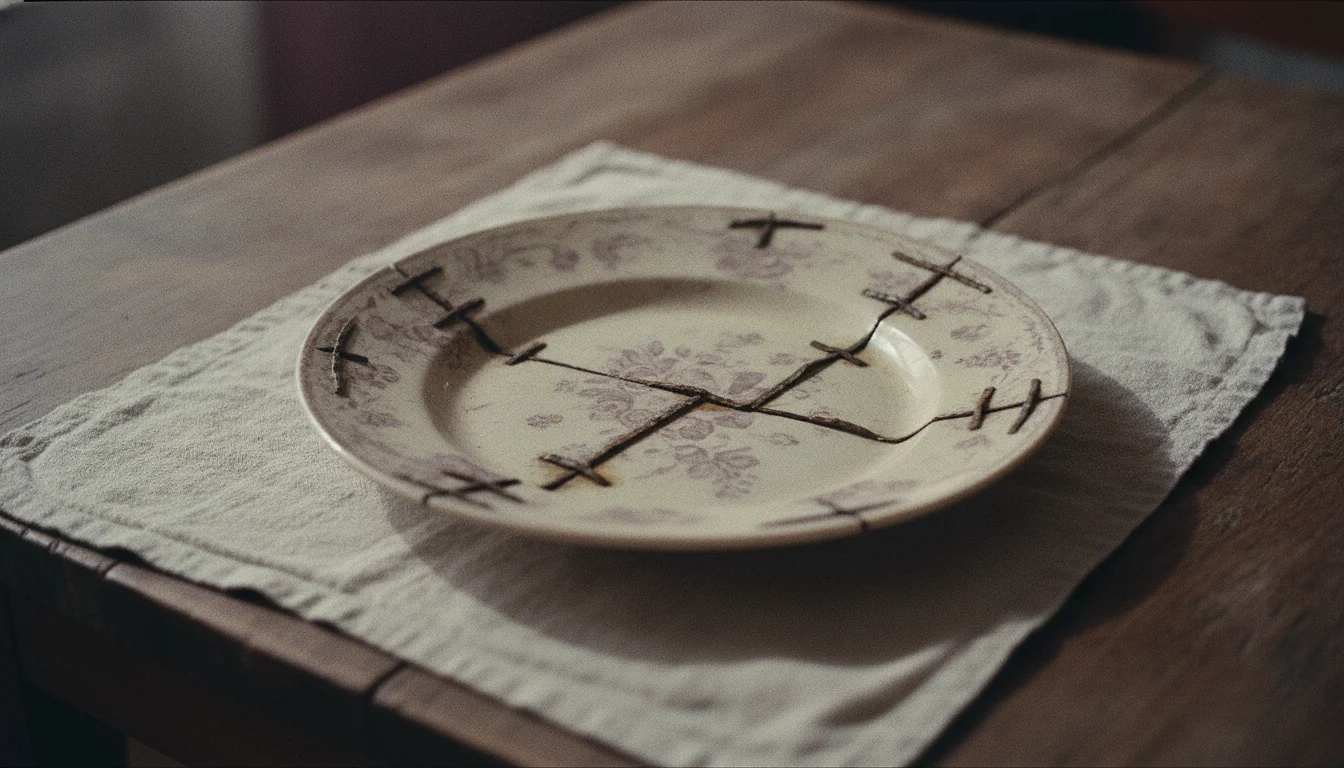
What does “karmic relationship” mean?
The karmic relationship meaning in everyday use is narrow, and people tend to reach for similar words for it: an intense, difficult bond, often on-and-off, that the person describing it believes happened for a reason. The reason is usually framed as a lesson, a debt, or unfinished business between two people.
Notice what that definition contains. It is a description of an experience plus an interpretation of why the experience occurred. The first half is a description a lot of people repeat. The second half is a belief, and this page is not the arbiter of anyone’s beliefs.
What the term does not contain is a threshold. Nobody can say where a hard relationship ends and a karmic one begins, because the phrase was never a category with edges. It is a way of talking about a relationship that hurt and felt significant at the same time.
Where does the word “karmic” come from?
Karma is a word from Indian religious and philosophical traditions, where it means action and the consequences of action. In Hindu, Buddhist and Jain thought it functions as a principle of moral causation: what a person does has effects, and those effects are not confined to the moment.
That is a general law about conduct. It is not a theory of couples. Nothing in the source material sorts people into karmic partners, and nothing in it says that a painful romance is a scheduled lesson delivered to one person by another.
The modern relationship usage came later, through twentieth-century Western spiritual writing, the same current that produced much of the popular soulmate vocabulary. If you want the longer version of how that vocabulary formed, it is set out in where the soulmate idea came from.
| Question | In the Indian traditions | In popular relationship usage |
|---|---|---|
| What is it about? | Action and its consequences | One specific person and one painful relationship |
| Who does it apply to? | Anyone, as a general principle of conduct | A partner cast as a teacher, or as a debt to be settled |
| What does it explain? | Why conditions arise; ethical causation | Why this relationship hurt, and why it repeated |
| What follows from it? | Responsibility for one's own actions | Often the belief that one must stay until the lesson is learned |
The last row is where the popular usage travels furthest from its source. A tradition about taking responsibility for one’s own conduct becomes, in the pop version, a reason to accept someone else’s.
What do people describe when they call a relationship karmic?
Strip the interpretation away and what is left is a description people tend to repeat. People describe attachment that formed unusually fast, a pull that persisted after the reasons to stay had run out, arguments that returned to the same shape no matter how they started, and a sense that the relationship was not finished even when it was over.
Those descriptions are worth taking seriously as descriptions. They are not signs in the diagnostic sense, and no list of them can tell anyone whether their relationship is healthy, doomed, or fine. A list can only tell you which words other people reached for.
There are ordinary explanations people give for parts of it, and they do not make the experience less real. People often describe attaching fast in periods of stress or heavy disclosure, and describe unpredictability as the thing that held their attention. When the same argument returns, what has usually not changed is what the two people do — that part is observable, whatever meaning someone assigns to it.
Is a karmic relationship the same as a soulmate or a twin flame?
They are three different labels from the same vocabulary, and the difference lives in the language rather than in nature. Soulmate usually names ease and recognition. Twin flame usually names intensity and mirroring. Karmic usually names pain with a purpose attached to it.
The overlap is real, which is why people argue about which word applies to the same relationship. Those arguments are almost always definitional. Two people using the same word for different things will not settle it with evidence, because there is no evidence to bring.
One practical difference: karmic is the one of the three most often applied in the past tense — people tend to say a relationship was karmic once they are out of it. For a side-by-side of the other two, see twin flame vs soulmate; for a term with a similar “hard to leave” flavour and a very different origin, see soul tie.
Can a karmic relationship be real love, and can it last?
Yes to the first, in the sense that matters to most people asking: the feeling was real. Calling a relationship karmic afterwards does not retroactively make the affection fake, and the framing many people use — that it was real and it was not workable — is coherent.
The second question the word cannot answer. Nothing in the label sets a duration. Whether a specific relationship lasts is decided by what two people do repeatedly: whether conflict gets repaired, whether both feel safe, whether the practical parts of life are agreed on rather than fought over.
That is the same test used on any relationship, and it is deliberately unglamorous. It is also the part of this subject that stays observable, which is why it is worth separating from the vocabulary.
Why “it was meant to happen” is not a reason to stay
This is the honest centre of the page. Belief in meaning changes behaviour, and in this particular term it tends to change it in one direction: toward staying. If the relationship exists to teach a lesson, then leaving before the lesson lands can be read as failure, and pain can be read as evidence that the process is working.
That reading is where the pop usage inverts its own source. A tradition about the consequences of one’s own action gets turned into an explanation for tolerating someone else’s. “Meant to happen” is a claim about the past. It says nothing about what should happen next.
Both readings can be held at once without contradiction. Someone can believe a relationship carried meaning and still decide that continuing it is not required by that meaning. Nothing in the word obliges anyone to remain in place while they work out what it meant.
What this page does not do
The category around this word sells certainty about the future. We are describing a vocabulary, so some questions get a plain refusal rather than a soft answer.
- No birth dates, charts, or number calculations
- Assigning karmic meaning to a date of birth belongs to numerology and astrology. No calculation of that kind can describe a relationship between two specific people, and we do not run them.
- No lesson-decoding
- We will not tell anyone what their relationship was supposed to teach them. That is an interpretation only the person living it can make, and outsiders who offer it for a fee are guessing.
- No reunion or ending forecasts
- Whether a former partner returns, and when, is not knowable from a label. Any page that claims otherwise is describing its business model, not your relationship.
Where this page stops
Recognition, intensity and a sense of fate are descriptions of feeling. None of them make a relationship safe, and none of them establish that two people are compatible. Intensity in particular is often mistaken for proof, and the karmic framing gives that mistake a vocabulary: the worse it feels, the more significant it must be.
If a relationship involves fear, control, coercion, or being made to feel unsafe, that is a safety question rather than a question about words or destiny. It is not something to resolve by working out what the relationship means. The right address is a qualified professional, or a helpline in your country, and the reason to contact them does not have to be an emergency.
That boundary is where this site’s remit ends. We can say where a word came from and what people usually mean by it. We cannot see a relationship, and we do not tell anyone what theirs is. The rest of the vocabulary is mapped in the words.