The soulmate idea is the belief that people come in matched pairs, and that meeting the right one is a matter of recognition rather than of construction. It is old, it has travelled through several traditions, and it arrived in modern English heavily edited. This section is about the idea itself: where it came from, what it is doing, and what changes for the people who hold it.
Two questions are usually asked at once here, and separating them resolves most of the argument. The first is whether destiny assigns partners. The second is whether the experience people call meeting a soulmate is real. Only the second can be described from the outside, and it is described constantly.
Why does the origin of the idea matter?
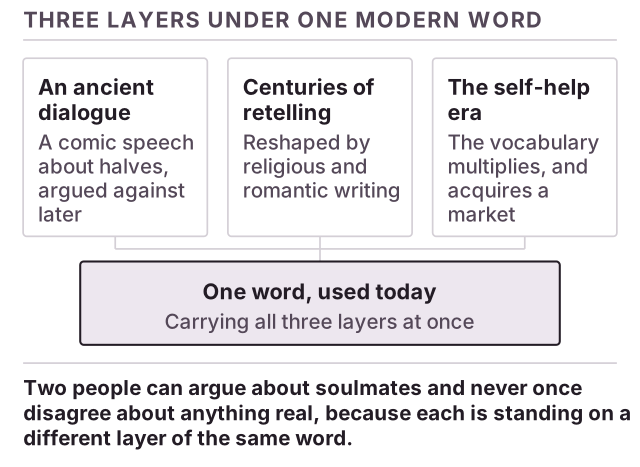
Because the version people quote is not the version that was written. The myth most often attributed to Plato is retold in a shape that leaves out its original context and its tone, and readers are regularly surprised when they meet the source. That is covered on where the idea came from.
Provenance also tells you what job the idea was doing at each stage. An image invented as part of a comic speech in a dialogue is doing something different from the same image used in a nineteenth-century love letter, or in a twentieth-century self-help chapter.
Is there a scientific version of this?
No, and pages that imply otherwise are borrowing authority they have not earned. There is a large literature on how adult bonds form and behave, and it is not about destiny. Mikulincer and Shaver’s 2012 review, An attachment perspective on psychopathology, is a fair sample of what that vocabulary is actually for.
The pattern is worth naming because it repeats across popular relationship writing. A popular framework is a memorable model that spreads because it is useful to think with, not because it was tested first. The five love languages is the clearest example: the framework itself is a book, and the scientific evaluation of it arrived much later, as in this review of the evidence. Soulmate writing has never had even that second step.
What does holding the belief change?
People describe it changing things in both directions, and both accounts are common enough to take seriously. Some describe the belief as what carried them through a bad stretch, because a relationship framed as significant is one worth being patient with. Others describe it as what kept them somewhere they had already decided to leave.
For instance, the sentence “we are soulmates, so I put up with it” is one this subject produces constantly. That is not an argument against the belief. It is a reason to notice what the belief is being asked to do in a particular situation.
What does this site refuse to do here?
Rule on anyone’s faith. This section describes what people believe, where the belief came from, and what they say it does. It does not appoint a winner, in either direction, and pages that quietly do so from the sceptical side are as much a failure as ones that do it from the other.
The honest position is narrower than either camp would like. The experience is real, the vocabulary is human and traceable, and the question of destiny is one we describe rather than settle.
Where does this section stop?
Where the idea starts doing harm, which is specific and worth naming. Nothing about a feeling of destiny makes a relationship safe, and “we are meant to be” is not evidence about how someone treats you.
If fear, control or coercion is part of the situation, that is a safety matter rather than a question about ideas. A qualified professional, or a helpline in your country, is the right reader for it.