
A soulmate is, in the way the word is most often used, a person someone feels unusually recognised by — a connection described as easy, fast and oddly familiar. That is a description of an experience, not a claim about how the person got there. A second sense sits underneath the first, in which the word means the one person fate selected, and most arguments about soulmates are two people using the two senses at once.
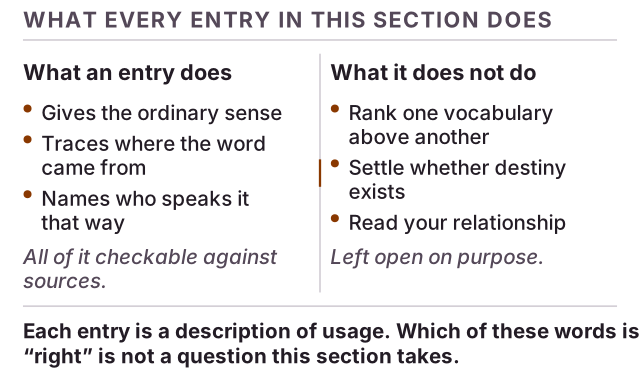
This section is a dictionary rather than a doctrine. Each entry sets out the ordinary meaning of a word, the tradition it arrived through, and the term it is most often confused with. Nothing here rules on whether the thing described is real; that question lives in where the idea comes from.
What do these words have in common?
They all name a feeling of significance and then explain it differently. Strip away the explanations and the reported experience is fairly similar across the vocabulary: recognition, speed, and a sense that this connection is not like the others. The disagreement starts at the next step, where each word supplies a different reason for the feeling.
A twin flame is, in the writing that uses the phrase, one soul divided between two bodies, whose reunion is expected to be intense and disrupting. A soul tie refers to a bond that persists after someone would like it to stop, and the phrase belongs to two separate traditions that rarely acknowledge each other. A karmic relationship means, in popular usage, a painful connection understood as one that had to happen for a reason.
Read as vocabulary, they stop competing. Each is a different frame placed over a similar report.
Do psychologists have a word for this?
Not for soulmates, but they do have a language for adult bonds, and it is worth knowing it exists. The most widely used frame grew out of attachment research: Hazan and Shaver’s 1987 paper Romantic love conceptualized as an attachment process proposed reading adult romantic bonds through the same lens that had been applied to infants and caregivers. The original lens came from John Bowlby’s Attachment, the first volume of his trilogy.
That literature is not about destiny and does not try to be. It describes how people behave when a bond matters to them. It is included here for one reason: readers often assume there must be a scientific term for soulmate, and there is not — there is a different vocabulary, answering a different question.
Why does provenance matter so much here?
Because knowing where a word came from settles arguments that otherwise run forever. Consider two people disagreeing about whether a twin flame outranks a soulmate. Neither is wrong about the language they learned; they simply learned it in different places, and the phrase has no governing body to appeal to.
Provenance also explains the mismatched emotional temperature of these terms. Words that arrived through devotional or spiritual writing, such as twin flame and soul tie, carry an expectation of ordeal. Words that arrived through romantic literature carry an expectation of comfort. The feeling being described may be identical.
Which page should I read first?
Read the entry for the word you actually encountered. For example, if a friend described their relationship as karmic, the karmic entry will tell you what they most likely meant, which is usually something about repetition and difficulty rather than about cosmic bookkeeping. If you found yourself reaching for “soulmate” and then hesitating, the soulmate entry is the one that takes the hesitation seriously.
The comparison pages — twin flame versus soulmate, soulmate versus life partner — do more work once you have read the individual entries, because a comparison is only as clear as its two halves.
What can a definition not tell you?
Whether a particular relationship is good for you. A word describes how a bond feels to the person naming it, and feelings of recognition occur in relationships that are kind and in relationships that are not. No entry in this section is a verdict on anyone’s situation, and none of them should be read as one.
If there is fear, control or coercion in a relationship, that is a safety question rather than a vocabulary one. A qualified professional, or a domestic-abuse helpline in your country, is the right reader for it.