
A sign of a soulmate is, in every list that uses the phrase, a description of something someone felt — not a measurement of anything about the other person. That distinction is the whole frame of this section. The experiences are real and widely described; what they are not is a test that anyone has passed or failed.
Four descriptions recur. Recognition means a sense of already knowing someone who is, in fact, a stranger. Ease refers to a drop in effort: less performing, fewer things needing explanation. Fast depth describes reaching the real material early, in a conversation that would normally take months to arrive. And a sense of safety describes the feeling that this person will not be careless with what they have been told.
What are people describing when they say they knew?
They are describing the first hours, and they describe them consistently. Talking longer than intended. Skipping the part where two people establish credentials. A familiarity that arrives before any of the facts do.
None of that is in dispute here, and the pages in this section treat it as the well-documented part of the subject. What follows the description is where the disagreement starts.
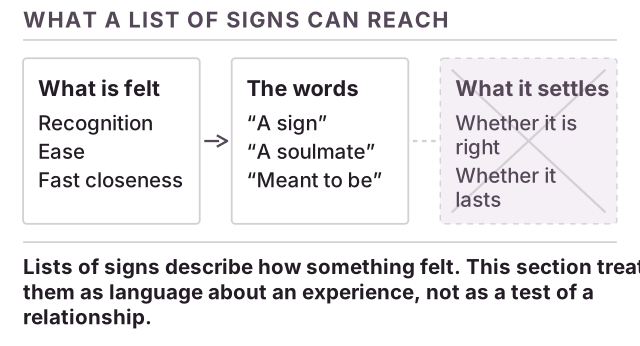
Can a sign tell you whether a relationship will work?
No, and this is the sentence the format of these lists keeps avoiding. A sign reports on a moment. Whether two people can disagree without damage, repair after conflict, or handle a bad year is not visible in a moment, and no amount of intensity brings it forward.
What has actually been examined is behaviour across time rather than first impressions. Gottman and Levenson’s 1992 paper Marital processes predictive of later dissolution followed couples and their interaction patterns rather than their origin stories, and the same group’s later work on predicting marital stability in newlywed couples took the same approach. Whatever one makes of that literature, it is looking at a different object than a list of signs is.
Why is intensity the least useful item on the list?
Because it is the one people reach for as proof, and it is produced by many things at once. Consider how similar the physical sensations are for attraction, nerves, novelty and fear. A connection can be genuinely extraordinary and also be loud for reasons that have nothing to do with fit.
For example, a meeting during a hard week, a move, or a crisis tends to be remembered as significant. The circumstances supplied part of the significance. That does not make the feeling counterfeit; it makes it a poor instrument for identifying a person.
Why do the stories all sound the same?
Because they are told after the ending is known. The “I knew from the first minute” account is assembled later, with the parts that did not fit the ending quietly left out. That is ordinary memory rather than dishonesty.
It has one consequence worth holding on to. The accounts that get told at all are the ones where something followed. Imagine the same first evening, with the same conversation, and nothing after it — nobody writes that one down, and nobody reads it.
Where does this section stop?
At the point where a page would have to pass judgment on your relationship. No page here can do that, because a page has no access to how either person behaves over months.
One line is worth stating plainly. If the idea that someone is meant for you is the reason you are staying somewhere that frightens you, that is exactly the harm this section is written to prevent. A professional or a domestic-abuse helpline in your country is the right reader for that, not another article.