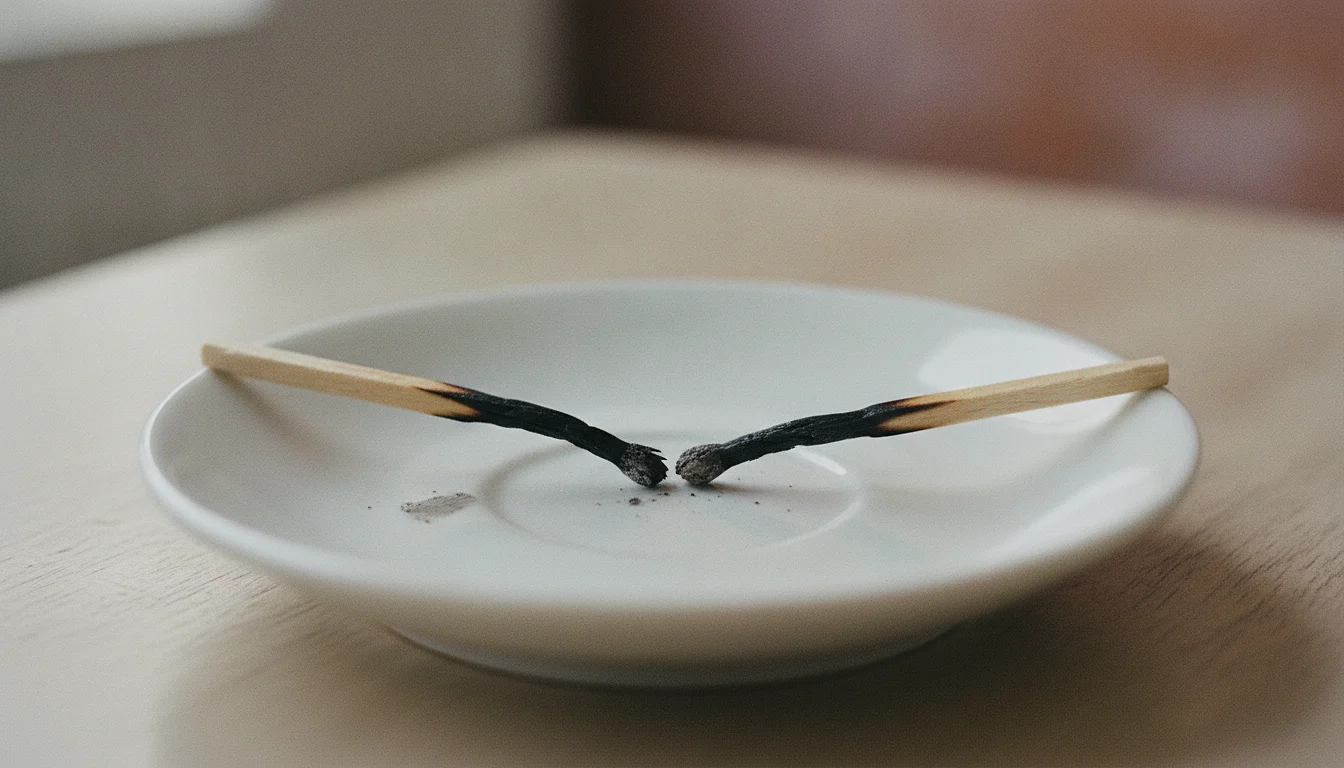
Writing that uses the phrase signs you met your twin flame comes back to the same handful: you recognised the person instantly, the intensity was out of proportion, they mirrored you, and the connection has been turbulent. Four items — the rest of any given list tends to be decoration on those.
This page describes that list as its users mean it, then looks hard at the fourth item. Recognition, intensity and mirroring are reports from inside an experience. Turbulence is the one that got turned into evidence, and that single move is what made the word dangerous.
What are the signs you met your twin flame?
Books, videos and forums tend to list the same items. Stripped of decoration, it comes down to four claims about how the connection felt.
- Recognition. A sense of already knowing the person, sometimes from the first moments of meeting.
- Intensity. Everything runs hotter and faster than the length of the acquaintance would explain.
- Mirroring. They reflect you back, including the parts you would rather not look at.
- Turbulence. Rupture, distance and return, treated as characteristic rather than as a problem.
Everything else circulating under the heading — finishing each other’s sentences, thinking of them the moment they call, feeling calmer in the same room, being unable to explain the pull to friends — is a variation on one of those four.
Where does the list come from?
Not from an ancient tradition, and not from anything with a governing body. The vocabulary belongs to twentieth-century new-age writing in English, and the sign lists themselves were built later, in self-help and then on social platforms, by people summarising what other people had described.
That origin explains the shape of the lists. They are crowd-assembled descriptions, refined by what readers recognised in themselves, which is also why they are so easy to recognise yourself in. We trace the word’s history separately on twin flame: where the term came from.
A young, informal word is not a fake word. It names something people struggled to name before. It just cannot borrow the authority of a tradition it does not belong to, and neither can a list of signs assembled from comment sections.
How do you know if someone is your twin flame?
You do not, and that is the honest answer rather than a coy one. There is no test, no marker and no qualified party who can confirm the label from outside. What exists is a feeling and a word people reach for to describe it.
The feeling is real. People are not imagining the jolt of familiarity, the speed, or the sense of being read without explaining themselves. Where the ground gives way is the step after that: treating a felt experience as a verdict about what the relationship is and what it owes you.
Anyone who offers to confirm it — through a reading, a chart, a paid assessment — is selling a certainty nobody has. The same applies in reverse: nobody can tell you it is not what you felt.
Why is turbulence on the list?
Because the word carries a story about difficulty being purposeful. In twin flame material, conflict is not a warning; it is the mirror doing its job, burning off whatever you have not dealt with. The pain is the mechanism, so the pain becomes the proof.
Follow the logic and the trap is visible. If the relationship is calm, that confirms the bond. If it is agonising, that confirms the bond more. If the person withdraws, that confirms it as well. A claim that survives every possible outcome is not being tested by any of them — it is being decorated by them.
This is the reason the term earns a warning that soulmate does not. A framework in which suffering counts as evidence of authenticity gives someone a reason to stay in a relationship they have already concluded is bad for them, and gives it in a vocabulary that sounds like devotion rather than damage.
Say it plainly: pain is not confirmation. If a connection keeps hurting, the hurt is information about the connection, not a certificate of its significance. That holds regardless of what anyone believes about souls, and this site takes no position on the souls.
Is intensity a sign of compatibility?
No, and that is the most useful sentence on this page. Intensity measures how strongly something is being felt. Compatibility is about whether two people can build a workable life — how money, stress, family, illness and boredom get handled between them.
Those are different questions. Strong feeling shows up in relationships that last and in relationships that do not. The most overwhelming connection of someone’s life can also be the most damaging. The vocabulary of destined pairs makes that hard to say out loud, which is exactly why it needs saying.
The ordinary explanations people give for recognition and intensity leave both fully genuine: shared references and background, mutual vulnerability offered early, meeting during upheaval, and a body that reads a racing pulse as significance. Naming an explanation does not delete the experience. It removes the obligation to treat the experience as a prophecy.
Do twin flames recognise each other?
These stories are frequently told from both sides — the same jolt, sometimes described in almost identical words. But they are told by the people inside them, so they cannot be read as a rate.
People describe that same jolt in strong mutual attraction generally, which means it does not mark the connection out as a different kind of thing. And the asymmetric case matters more: when only one person feels it, no amount of certainty on one side creates a bond on the other. A sign felt alone is a feeling, not a relationship.
Are these the same as soulmate signs?
They overlap heavily, and they lean in different directions. Soulmate lists lean towards ease, comfort and fit — the person you do not have to translate yourself for. Twin flame lists lean towards intensity, mirroring and difficulty.
The difference is in the language rather than in nature. Nobody has established two categories of person; there are two vocabularies, chosen according to which part of an experience the speaker wants to emphasise. The two dictionaries sit side by side on twin flame vs soulmate, and the broader question of whether any of it is real is handled on are twin flames real?.
What the signs cannot tell you
A list of signs is a description of a feeling. It does not measure a relationship, and it cannot answer the questions people actually bring to it.
It cannot tell you whether the other person feels the same. It cannot tell you whether the relationship is safe. It cannot tell you whether you are compatible, whether it will last, or whether leaving would be a mistake. It cannot rank your relationships, however often the tiers get presented that way.
The other thing worth noticing: the signs describe the first hours and the hardest hours, and nothing in between. Most of what a relationship actually consists of lives in the unremarkable middle — and that part never appears on a list, because it does not feel like a sign.
What is worth watching instead?
Things you can observe over time rather than sense in a moment. Whether disagreements get repaired or merely survived. Whether both people are honest when honesty is inconvenient. Whether the other person’s word and behaviour match when nobody is watching.
Whether you can say no in small matters without a price being extracted. Whether you like who you become in their company. Whether your relationships with other people have grown or quietly disappeared since this one started.
None of that is mystical, and none of it is a substitute for the recognition feeling — the two can happily coexist. But only one of them says anything about the months ahead. The rest of the hub, the signs, takes the same approach to the other lists people search for.
Where this page stops
Recognition does not make a relationship safe, and intensity is not evidence of compatibility. Someone can believe fully in twin flames and still be in a relationship that is harming them; the label offers no protection, and it can become a reason to stay somewhere you have already decided to leave.
If there is fear, control, coercion, or a pattern of being hurt and then told the pain is proof of the bond, that is a safety question rather than a question about souls, and no sign list can address it. It belongs with someone qualified: a therapist or counsellor, a domestic-abuse service, or a helpline in your country. This site describes what words mean. It cannot see your relationship, and it does not try to.